
If you have been watching Jensen Huang’s keynote speeches or following discussions about AI/ML, you may have heard of CUDA. I personally didn’t know what it was. From the way people talked about it, it felt like a programming language that had something to do with GPUs. Then I tried to look into the details, and boy, the explanations on the internet couldn’t be much harder to grasp. Wikipedia has detailed information, sure, but Wikipedia being Wikipedia, they just couldn’t have made it any more complicated.
Anyways, let’s discuss my findings in simpler terms. You can always go to NVIDIA’s blog and Wikipedia to know the technical details later.
So, CUDA (Compute Unified Device Architecture) was built by NVIDIA to let developers write code for GPUs (Graphics Processing Units). Originally based on C, it later expanded to support C++. But it’s not exactly a separate language that translates into C++. Instead, it’s an extension of C and C++. When you write CUDA code, a special compiler splits it up: the standard C/C++ instructions go to your CPU, and the specialized parallel instructions are converted into low-level machine code specifically for the GPU.
GPU vs CPU
Now, if you don’t know why a dedicated platform is needed for a GPU, you have to look at how CPUs and GPUs differ in how they work. A CPU works in sequential order. One core handles one task at a time. To handle multitasking, CPUs were engineered to switch between tasks so quickly that it creates the illusion of simultaneous, parallel work. This is how multitasking across many apps came into being. Over generations, CPUs got more cores to provide more processing power. If your CPU has 4 cores, it generally means it can truly handle 4 tasks at exactly the same time, and by shifting rapidly, it gives you much smoother multitasking than a single core ever could.
GPUs, on the other hand, were developed to work in parallel from the ground up. Their individual cores are actually a lot less powerful than CPU cores. But they were developed for graphics in the first place. A standard screen has millions of pixels (a 4K screen has over 8 million!). The color of every single pixel has to be calculated and defined by the hardware dozens of times a second. For this kind of work, a CPU significantly lags behind. Even though it has smarter cores, a CPU core handles tasks sequentially.
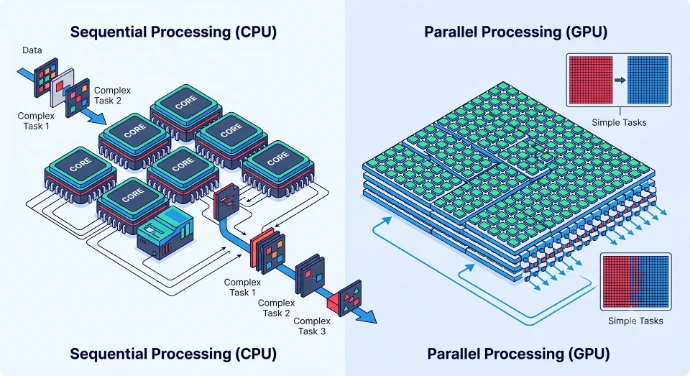
The real difference becomes obvious when your 14-core CPU is compared to a GPU that has thousands of cores. By the way, GPU cores also handle one task at a time, but the sheer volume of cores is just too much compared to a CPU. 14 fast cores cannot beat thousands of slower cores working simultaneously in parallel.
That’s why CPUs and GPUs work in a partnership: the CPU handles complex tasks that need sequential logic, and the GPU handles massive amounts of simple tasks in parallel where needed.
What CUDA does fundamentally
Now, let’s get back to CUDA. Our programming languages are designed so that we have to define how software functions interact with the hardware. With a CPU having a small number of cores, this is manageable. But a GPU makes it quite hard to write efficient code because there are thousands of cores, threads, and complex internal connections. Manually defining how to distribute tasks across thousands of cores and managing the memory between them is incredibly complicated.
This is where CUDA comes in. It gives programmers an easier route. Developers can focus on building their applications, while the CUDA framework handles how to interact with the GPU hardware in the most efficient way possible.
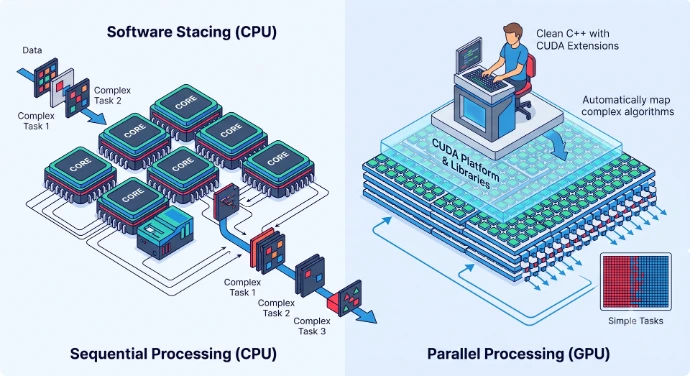
CUDA is, however, NVIDIA's proprietary platform. If you write your raw code in CUDA, it will only work on NVIDIA hardware. Competitors have their own versions: AMD’s graphics cards use ROCm, and Intel uses oneAPI.
You might be wondering, "Then how come a video game works on whatever graphics card I buy?" That is because general-purpose software—like games, 3D modeling tools, and video editors—is built using industry open standards like DirectX, Vulkan, or OpenCL. These are alternative ways to talk directly to the GPU drivers to render graphics, rather than relying on a platform like CUDA.
But for massive industrial computing, companies want the absolute best performance, so they build applications specifically for the hardware they are using—coding directly for CUDA, ROCm, or oneAPI.
Evolution From Graphics Only
CUDA started as a GPU programming tool, but it has become so much more. When researchers realized that GPUs could do lots of simpler math work in parallel, they started using them for tasks that had nothing to do with graphics. The tech industry even has a specific term for this: GPGPU (General-Purpose computing on Graphics Processing Units). Because of this shift, GPUs evolved to handle:
Linear Algebra
Signal Processing & Fourier Transforms
Vector Calculus
Numerical Analysis & Differential Equations
Discrete Mathematics & Graph Algorithms
Probability & Stochastic Processes
CUDA had to expand to house all these functionalities so the GPU could easily execute these complex mathematical operations.
These are the exact operations needed for scientific research, massive simulations, and today’s hottest topic: AI. Because NVIDIA pioneered this GPGPU shift just as the AI boom hit, CUDA became the foundational platform for AI development.
What's fascinating is that today, most AI developers don't even write raw CUDA code. They write relatively simple Python code using popular AI frameworks like PyTorch or TensorFlow. But under the hood, those frameworks are completely built on CUDA. CUDA acts as the "invisible layer" doing all the heavy lifting to make modern AI possible.
CUDA has grown into such a massive ecosystem that its full name, "Compute Unified Device Architecture," doesn't really cover it anymore. Even NVIDIA spokespersons avoid the full name now and just call it CUDA. It is no longer just a device architecture—it is a massive suite of specialized AI libraries and development tools. It also isn't limited to a single GPU inside one computer anymore; it seamlessly supports multiple GPUs working together across massive data centers.

However, CUDA becoming this important isn’t just a story of technological endeavor. It is the result of a brilliant, long-term business strategy and a marketing masterclass. We will discuss exactly how NVIDIA pulled that off in the next blog post.